Headphone Impedance, Sensitivity (dB/mW vs dB/V), Damping Factor, and Balanced Amplification Engineering
Few topics in audio engineering generate more confusion than matching headphones to headphone amplifiers. Why can a 300-Ohm Sennheiser HD 650 play louder from a studio interface than a 13-Ohm Dan Clark Stealth? Why do manufacturers publish sensitivity in two incompatible units (dB/mW vs. dB/V), and how does an amplifier’s output impedance alter the bass … Read more
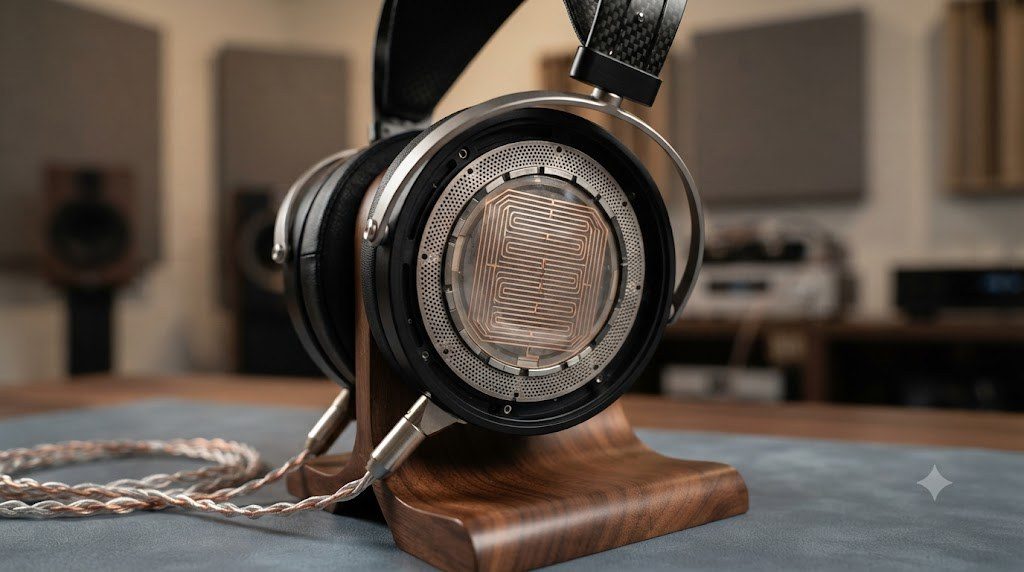
Headphone Transducer Topologies: Dynamic Bio-Cellulose, Planar Magnetic Isodynamics, Balanced Armature, and Electrostatic Stators

Unlike room loudspeakers that must pressurize puluhan cubic meters of air across several meters of distance, headphone transducers operate into a microscopic coupled acoustic cavity—the human pinna and ear canal (approximately 2 to 6 cubic centimeters of air volume). Freed from the requirement of moving massive air volumes, headphone engineers can utilize exotic ultra-low-mass transducer … Read more

Studio Monitor Calibration & Room Acoustics: Axial Standing Waves, Schroeder Frequency, and Porous Bass Traps

Even a $20,000 pair of mastering studio monitors with a +/- 0.5 dB anechoic frequency response will exhibit catastrophic +/- 15 dB to 25 dB peaks and nulls below 300 Hz when placed inside an untreated rectangular room. In any studio control room, the room itself is the final component of the loudspeaker system. Mastering … Read more

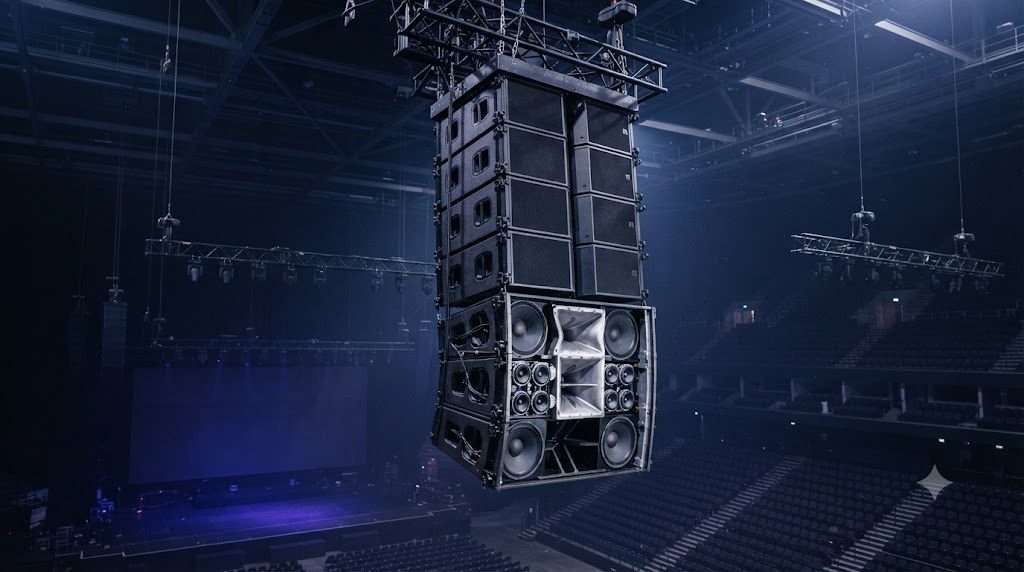
Constant-Directivity Waveguides, Horn Loading, and Line Array Cylindrical Wavefront Physics

Even a loudspeaker with a ruler-flat 0-degree on-axis frequency response in an anechoic chamber will sound colored and unbalanced in a real room if its off-axis dispersion (directivity) fluctuates wildly across the crossover region. Because human listeners in domestic rooms and control studios hear a blend of roughly 30% direct sound and 70% reflected room … Read more

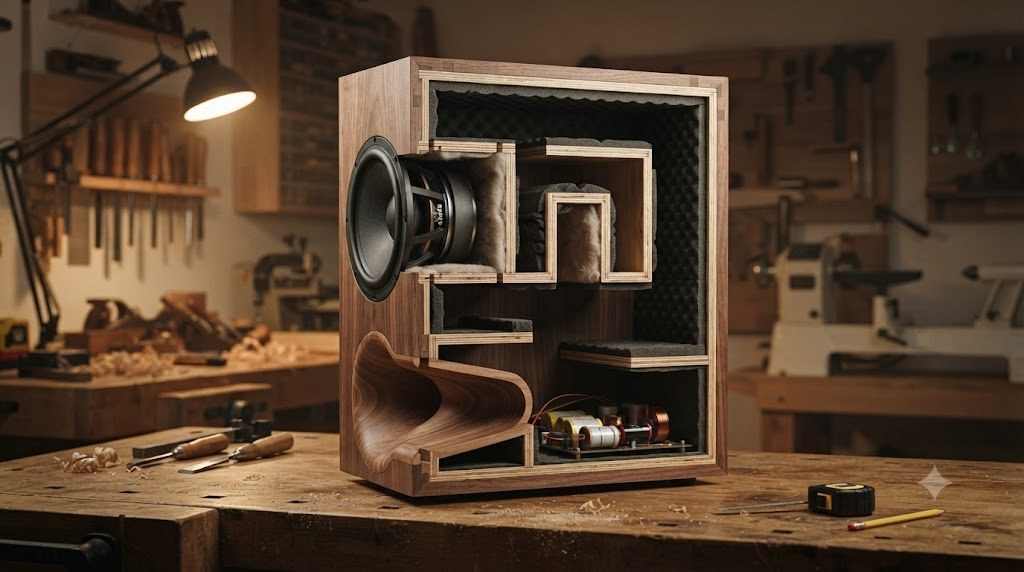
Loudspeaker Enclosure Acoustics & Thiele-Small Parameters: Sealed Qtc, Helmholtz Bass-Reflex, and Transmission Lines

A raw loudspeaker woofer suspended in open air is an acoustic disaster at low frequencies: as the cone moves forward, compressing air in front of it, the rear surface simultaneously creates an equal and opposite rarefaction zone behind it. At bass wavelengths where the physical diameter of the woofer frame is small relative to the … Read more

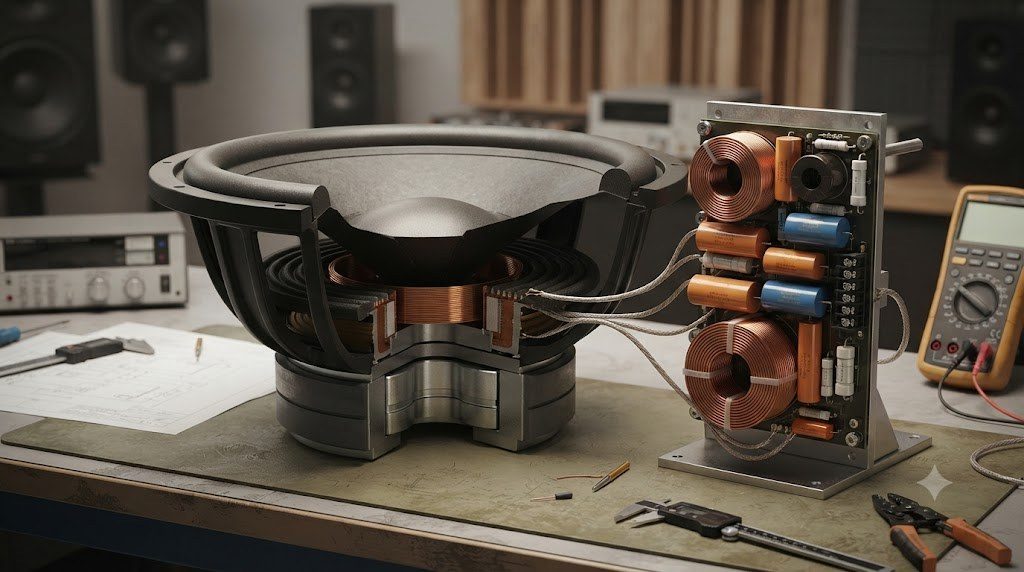
Loudspeaker Driver Motors & Crossover Networks: Voice Coil Physics, Linkwitz-Riley Filters, and Active DSP

Reproducing the full 10-octave audible frequency spectrum (20 Hz to 20,000 Hz)—where wavelengths span from 17 meters at the sub-bass extreme down to 1.7 centimeters at the high-frequency limit—is physically impossible for a single moving cone without incurring severe high-frequency beaming, intermodulation distortion, and cone breakup. Multi-way loudspeaker systems solve this acoustic paradox by dividing … Read more

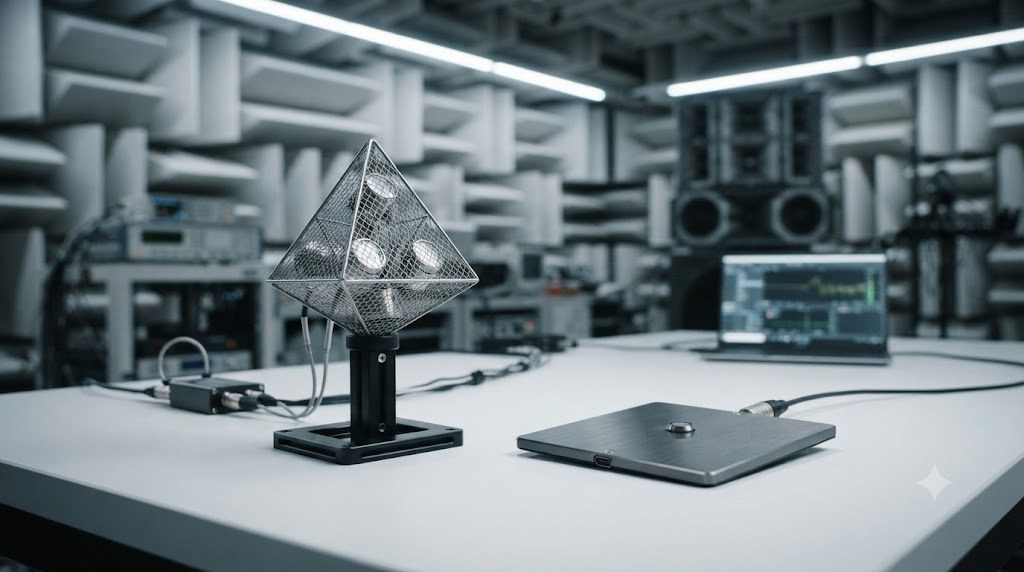
Specialized Acoustic Capture: Silicon MEMS Arrays, Boundary PZM Physics, Parabolic Dishes, and 3D Ambisonics

Beyond traditional handheld and stand-mounted studio transducers lies a rapidly advancing frontier of specialized acoustic capture technology. From microscopic lithographically etched silicon MEMS (Micro-Electro-Mechanical Systems) arrays embedded in spatial computing headsets and smartphones, to hemispherical Pressure Zone Boundary (PZM) transducers and tetrahedral Spherical Harmonics Ambisonic arrays for 360-degree virtual reality audio, modern acoustic engineering merges … Read more

Phantom Power (+48V), Balanced XLR Interconnects, and Microphone Impedance Bridging Engineering

A microphone capsule generates minuscule electrical signals—often measured in mere millivolts or microvolts—that must traverse tens or hundreds of meters of copper cabling through electromagnetically hostile studio and live stage environments before reaching a mixing console’s preamplifier. Without differential balanced transmission, precision resistor matching, and proper voltage-bridging impedance ratios, these fragile analog signals would be … Read more

Acoustic Polar Patterns & Stereo Miking Arrays: Cardioid Equations, Proximity Effect, and Blumlein Pair Geometry

A microphone’s directional polar pattern is not generated by digital filtering or electronic EQ—it is a masterpiece of acoustic delay networks, phase cancellation, and dual-membrane voltage summation. Understanding the mathematical polar equations governing Omnidirectional, Cardioid, Supercardioid, Hypercardioid, and Figure-8 responses allows recording engineers to maximize signal-to-bleed isolation, control room reverberation ratios, and construct phase-coherent stereo … Read more

Microphone Transducer Physics: Dynamic Moving-Coil, Condenser, and Ribbon Acoustics Explained

Every acoustic recording begins at the primary electro-acoustic interface: the microphone transducer. Whether capturing the sub-millisecond transient snap of a snare drum, the delicate harmonic overtones of a solo violin, or the high-SPL roar of a guitar amplifier cabinet, the physical transducer mechanism dictates how acoustic air pressure variations are converted into alternating electrical voltages. … Read more